
Pikeville Bench Warrants Stay With the City Court
A missed Pikeville Municipal Court appearance should first be checked with the City Court Clerk. City traffic, parking, and ordinance matters are distinct from Bledsoe County General Sessions and Circuit/Criminal cases. The countywide Sheriff contact may help with service information, but the city court controls its own docket and any order arising from it.
Ask whether the matter remains a citation, has been set for another date, or has advanced to a bench warrant or capias. The official Pikeville page does not publish a public warrant lookup or a universal recall rule.
Pikeville Municipal Court information lists the clerk and payment channels.
Bledsoe County Bench Warrants Explained
A bench warrant generally follows a failure to meet a court obligation, often a missed appearance. Tennessee courts may use a bench warrant or capias for failure-to-appear matters. Bledsoe County's court layers are decentralized, so the process remains attached to the court that scheduled the case. A city citation, General Sessions matter, and felony case do not share one warrant desk.
Do not assume that an unpaid fine automatically has the same consequence in every case. Ask the clerk what order the judge entered and what action is needed to return the matter to court.
General Sessions and Circuit Warrants Cover Different Bledsoe Cases
General Sessions Court handles limited-jurisdiction criminal and traffic matters, preliminary hearings, and other work authorized by state law and local private acts. Bledsoe Circuit and Criminal Court handles trial-level criminal work. Both court levels can have process connected to their own cases, and a clerk needs the case details to identify the right record.
The Administrative Office of the Courts describes General Sessions jurisdiction as county-specific. A Bledsoe County resident should read the court name on the notice rather than infer jurisdiction from the courthouse address alone.
The Administrative Office of the Courts General Sessions page explains this limited-jurisdiction court level.
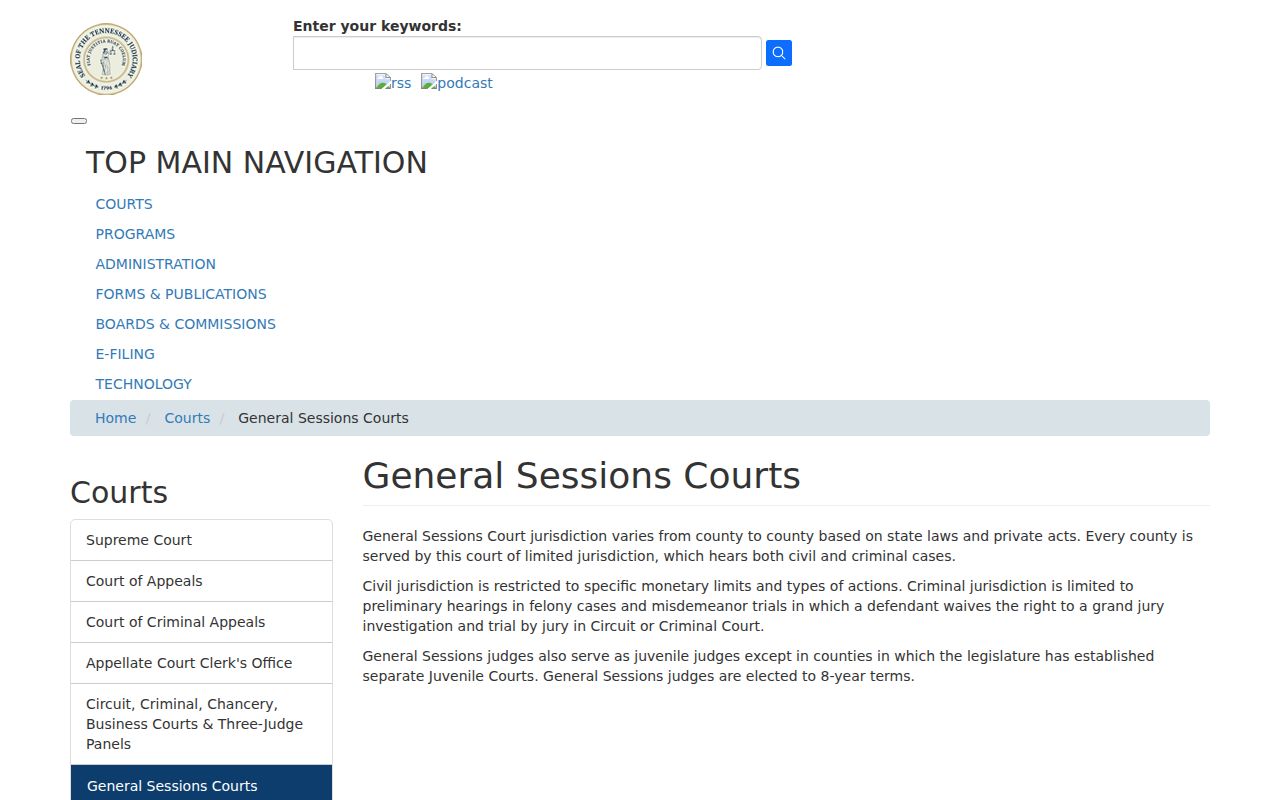
This state court overview explains the court level; the Bledsoe clerk confirms the local case.
How Bledsoe County Bench Warrants Are Issued
The court sets a required appearance or obligation. If the person does not comply, a judge may issue process directing law enforcement to bring the person before the court. The exact steps, notice, and timing depend on the case and applicable law; the Bledsoe research did not find a countywide grace period that applies to every docket.
After issuance, the order remains with the court and may be shared through restricted criminal-justice systems. A public statewide self-search is not available in Tennessee. Ask the clerk whether the order has been recalled or whether another hearing must be set.
Tennessee Rule 9's Capias Language for Bledsoe Warrants
Tennessee Rule of Criminal Procedure 9 uses the phrase “capias or summons upon indictment or presentment.” The term capias also appears in current law for certain failure-to-appear processes. It describes court process, not a separate public database. Bledsoe County clerks can identify the actual order and explain which court has authority to change it.
Do not infer that every capias follows the same path as a summons or a bench warrant. The underlying docket, judge's order, and case stage matter. Ask the clerk to name the process recorded in the file.
Tennessee's criminal rules index links Rule 9 and related procedures.
Rule 9 helps explain why notices and arrest-directed process may both appear in a criminal case, but it does not publish Bledsoe docket status. The clerk can tell a caller what action the file records and where the case is assigned; only the court can change its order. Ask whether the matter is listed as a summons, capias, or bench warrant and whether a new appearance date is required. That distinction matters before paying a citation or relying on a third-party case entry, because a payment record alone does not show that the judge recalled process.
A Tennessee law effective July 1, 2025 changes transmission and approval steps for a limited class of failure-to-appear cases. It does not end bench-warrant authority or create a public search page. Ask the issuing clerk whether the specific case falls within that statutory category and what action the court recorded.
Bench Warrants and Arrest Warrants Compared
A Bledsoe County bench warrant responds to a court obligation already in a case. An arrest warrant begins with probable cause tied to an alleged offense. Both may authorize an arrest, but they arise at different stages and are handled through the court that issued them. See arrest warrant procedures for the companion process.
| Feature | Bench Warrant | Arrest Warrant |
|---|---|---|
| Trigger | Missed appearance or court obligation | Probable cause of an offense |
| Who issues | Judge of the court holding the case | Judge or magistrate |
| Underlying file | Existing case with an unmet requirement | Investigation or filed charge |
| Next step | Ask about recall, reset, or appearance | Confirm charge, bond, and court date |
No Bledsoe County Bench Warrant Walk-In Rule Is Published
The source review found no countywide walk-in recall docket, online motion form, or fixed grace period for Bledsoe County bench warrants. Before visiting, call the clerk for the issuing court and ask whether the judge requires a scheduled motion, a new setting, or an appearance. Courthouse hours and the responsible clerk can differ by office.
A records page or payment receipt alone does not change the court's order. Request confirmation of the disposition and keep written proof of any recall or reset.
Resolving a Bledsoe County Bench Warrant
The court that issued the process controls its recall. A lawyer can contact the clerk, review the docket, and advise whether to seek a reset, file a motion, or arrange an appearance or surrender. The Sheriff can explain service or booking, but cannot lift the judge's order. Resolve the underlying obligation as directed by the court.
- Ask the clerk which court issued the order and whether it remains active.
- Talk with a Tennessee attorney about recall, a reset, or a scheduled appearance.
- Follow the court's instructions for appearing or arranging voluntary surrender.
- Complete the ordered step and obtain written confirmation that the docket was updated.
Caution: Do not assume a bench warrant has expired or cleared; verify its status with the issuing court before making plans.
License Compliance Is Separate From a Bledsoe Bench Warrant
Tennessee Safety describes a notice and 30-day period for some failure-to-appear compliance matters, with a listed $65 reinstatement fee. That process concerns driver-license compliance and is separate from the court's warrant status. A release sent to Safety does not by itself show that the court recalled its order, and a court payment does not guarantee that every license step is complete.
Ask the Bledsoe clerk what court action is required, then ask Tennessee Safety what proof it needs if a compliance hold applies.
Tennessee Safety's FTA notice explains that compliance window.
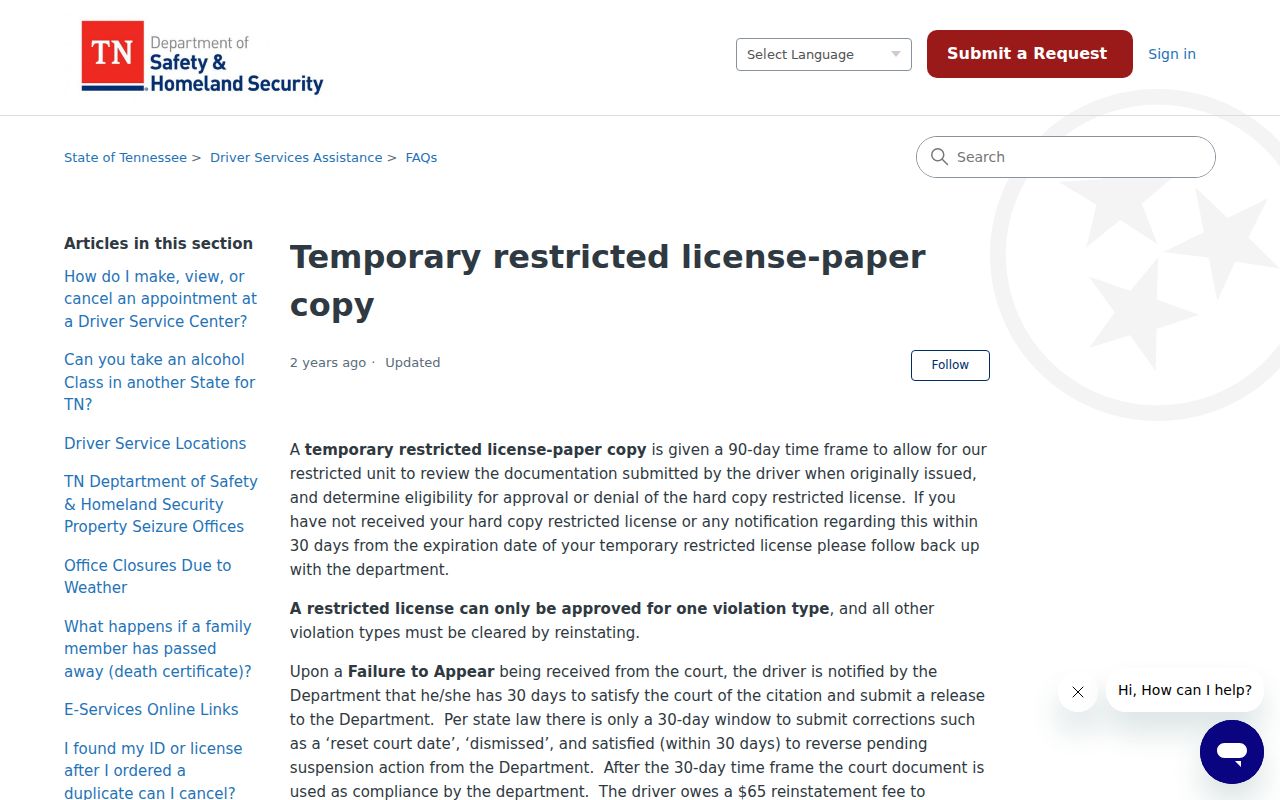
The notice concerns license compliance and does not recall a court's bench warrant.
Finding the Bledsoe Court That Issued a Bench Warrant
Look first at the citation, summons, or hearing notice. A city ordinance or traffic matter may belong to Pikeville Municipal Court; county-level traffic and misdemeanor matters may go through General Sessions; felony trial matters route through Circuit or Criminal Court. Each Bledsoe County court keeps its own records and decides whether its order should be recalled.
If the court is missing from the paperwork, call the Circuit Court Clerk at (423) 447-6488 for routing and the Sheriff's Office at (423) 447-2197 for county service questions. For more Bledsoe County warrant contacts, use the county overview.